

Chamber of the Great Council: Complete Guide to the Doge’s Palace Main Hall
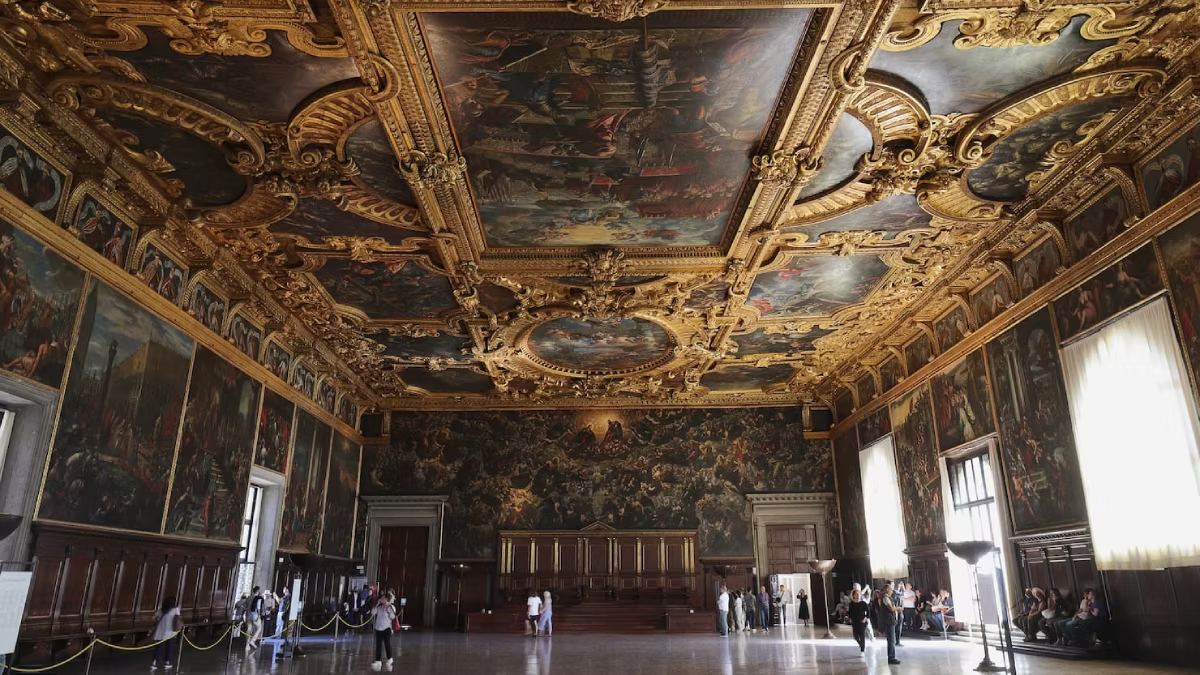
The Sala del Maggior Consiglio (Chamber of the Great Council) is the single most impressive room in the Doge’s Palace — and arguably in all of Venice. Measuring 53m × 25m, it is the largest single room in Europe without internal supporting columns. Up to 2,000 members of the Venetian nobility met here to legislate and elect magistrates. The back wall is dominated by Tintoretto’s Paradise (1588–1592), a 22m × 9m oil painting containing around 500 figures — historically the largest oil painting on canvas in the world. The upper walls display 76 portraits of doges including the famous black curtain covering the image of Marin Falier (executed for treason in 1355). Allow 15–25 minutes minimum in this room.
Walking into the Chamber of the Great Council is the climactic moment of a Doge’s Palace visit. Everything in the standard route — the smaller Doge’s Apartments, the intricate Collegio and Senate rooms — leads here. The scale, the wall-filling Paradise, the ring of Doge portraits, and the sheer political weight of what happened in this room all converge. This guide explains exactly what you’re looking at, why it matters, and how to see it properly.
The Room Itself
The Chamber of the Great Council is 53 meters long, 25 meters wide, and 12 meters tall. It occupies the majority of the second floor on the lagoon side of the palace. Large windows along the south wall overlook St. Mark’s Basin. The flat wooden ceiling is divided into painted panels by Veronese, Tintoretto, and Palma il Giovane. The Doge’s throne was positioned at the east end, with the Paradise painting rising behind it. Members sat on long benches arranged in ranks down the length of the room.
| Feature | Measurement |
|---|---|
| Length | 53 meters (174 ft) |
| Width | 25 meters (82 ft) |
| Height | 12 meters |
| Floor area | ~1,300 m² |
| Capacity | 1,200–2,000 members |
| Location | Second floor, southern side |
The room was rebuilt after the catastrophic fire of 20 December 1577, which destroyed the original decorative program including frescoes by Guariento di Arpo (1365). The reconstruction preserved the room’s dimensions but replaced the original fresco decoration with the painted wall canvases and wooden ceiling program visible today.
What Happened Here: The Maggior Consiglio
The Great Council (Maggior Consiglio) was the broadest legislative body of the Venetian Republic — the assembly of all adult male members of the Venetian nobility. Meetings occurred Sundays and high holidays, typically with 1,200–1,500 attendees. The Council elected magistrates, senators, the Doge himself, and approved major legislation. The room was designed to impress both its members and foreign ambassadors with the grandeur of Venetian republican government.
Key functions performed in this room:
- Election of the Doge: through an elaborate multi-stage voting process involving selected electors
- Election of senators and magistrates: filling the hundreds of positions that ran Venice’s government
- Legislative approval: of major laws and foreign treaties
- Judicial review: of appeals on serious cases
- Public acclamations: of Venetian military victories and state events
The Council’s broad membership (all adult male nobles by birthright) distinguished Venice from most European states. The Great Council’s permanence and size made it the single most visible symbol of Venice as a republic rather than a monarchy — hence the ceremonial grandeur of the room.
Tintoretto’s Paradise
Paradise (Il Paradiso) is the massive oil painting covering the back wall behind where the Doge’s throne sat. Painted by Jacopo Tintoretto between 1588 and 1592 (when he was around 70 years old), with significant work by his son Domenico and the family workshop. Dimensions are approximately 22 meters wide and 9 meters high. The painting contains around 500 individual figures arranged in circles of light radiating from Christ and the Virgin Mary at the center. At the time of its creation, it was the largest oil painting on canvas in the world. Replaced a 1365 Guariento fresco destroyed in the 1577 fire.
Dimensions and facts
- Dimensions: 22m × 9m (72ft × 30ft): roughly the size of a tennis court
- Medium:: Oil on canvas, multiple canvases sewn together
- Painted: 1588–1592
- Painters:: Jacopo Tintoretto (lead), Domenico Tintoretto (son), workshop assistants
- Subject:: The Christian Paradise, with Christ crowning the Virgin Mary at the center
- Figures:: Approximately 500 saints, angels, prophets, and Biblical personages
- Historical claim:: Largest oil painting on canvas in the world at its creation
The competition and commission
The commission originally went to Paolo Veronese and Francesco Bassano after a 1582 competition. Veronese died in 1588 before beginning work, and Bassano had not yet started. The commission transferred to Tintoretto, who was already around 70 years old. He completed the work in approximately four years with substantial help from his son Domenico and workshop assistants.
How to look at Paradise
The painting rewards multiple distances:
- From the far end of the room: you see the overall structure: concentric circles of light radiating from the central figures of Christ and Mary
- From the middle of the room: you begin to pick out individual Biblical and saintly figures
- From close up (as close as you can get): you see the detail of individual faces and the tremendous compositional density
From the Doge’s throne position (which visitors can approximate), the painting’s radiating structure aligns geometrically. Tintoretto designed the perspective for this specific viewpoint.
Symbolic significance
The painting is not merely religious decoration — it’s a political statement. The Doge sat beneath it during council meetings, with:
- Christ and Mary: directly above the throne: signifying divine sanction of Venetian governance
- The Dove of the Holy Spirit: positioned over the Doge’s head: suggesting divine inspiration for Venetian laws
- Hierarchical organization: (archangels, prophets, saints in descending rank): mirroring the Republic’s own hierarchy (Doge, senior magistrates, Council members)
For Venetian nobles meeting in this room, the visual message was unmistakable: decisions made here carried divine weight.
See the full guide to Venetian art in the palace: Top Doge’s Palace Artworks Guide and Tintoretto and Veronese’s Ceilings.
The 76 Doge Portraits
A frieze of 76 portraits of Doges circles the upper walls of the chamber. Every Doge from Obelerio Antenoreo (804 AD) to Francesco Venier (1556) is represented, plus later Doges to the 18th century. The most famous feature of the portrait series is the black curtain covering the position where Marin Falier’s portrait would appear — Falier was convicted of treason and executed in 1355, and the Venetian Senate ordered his likeness obliterated from public memory. The inscription on the black panel reads “Hic est locus Marini Faletro decapitati pro criminibus” (This is the place of Marin Falier, beheaded for his crimes).
The portraits sequence
- First portraits begin: at the west end of the room, above the entrance
- Continue around: the room in chronological order
- Final portraits: date to the end of the Venetian Republic (1797)
- Most by various 16th–17th century Venetian painters, repainted after the 1577 fire
The portraits are modest in scale — focused on standardized ducal portraiture rather than individual artistic statement. They function more as a historical record than as art objects.
The Marin Falier affair (1355)
The empty space where Marin Falier’s portrait should appear is one of the most dramatic features of the room. Falier, the 55th Doge, was convicted of conspiring to overthrow the Venetian Council and install himself as absolute ruler. He was beheaded at the top of the Giants’ Staircase in April 1355, and the Senate ordered:
- His portrait erased from the Great Council Chamber
- His name struck from official records
- His image never to appear in public Venetian spaces
The black-painted panel with its Latin inscription serves as both memorial and warning — a deliberate absence representing the Venetian state’s power to erase as well as commemorate. It became a Romantic literary subject in the 19th century, inspiring works by Byron, Donizetti, and others.
The Ceiling
The flat wooden ceiling is divided into painted panels set in elaborate gold-and-blue frames. Three large central canvases dominate: Tintoretto’s “The City of Venice Offering a Laurel Wreath to Doge Nicolò da Ponte” (1584), Veronese’s “The Apotheosis of Venice” (1585), and Palma il Giovane’s “Venice Crowned by Victory Receiving the Conquered Provinces.” Smaller panels celebrate Venetian military victories. Plan to spend 5–10 minutes looking up at the ceiling alone — it’s one of the most ambitious ceiling programs in European art.
Main ceiling paintings
| Work | Artist | Date |
|---|---|---|
| The Apotheosis of Venice (central oval) | Paolo Veronese | 1585 |
| The City of Venice Offering a Wreath to Doge Nicolò da Ponte | Jacopo Tintoretto | 1584 |
| Venice Crowned by Victory | Palma il Giovane | c. 1587 |
| Military victory panels (various) | Various | 1580s–1590s |
Veronese’s “Apotheosis of Venice”
Veronese’s oval centerpiece depicts Venice as a female figure being crowned in glory by Victory, surrounded by allegorical figures representing peace, abundance, and justice. Below the ascending figure of Venice, a balcony filled with Venetian nobility and ordinary citizens looks up — a clever device that creates a visual connection between the ceiling and the room’s actual inhabitants.
This is considered one of Veronese’s masterpieces and his most important ceiling program in the palace.
Other Artworks on the Walls
Beyond Tintoretto’s Paradise on the end wall, the long side walls feature a cycle of paintings celebrating Venetian history and military victories, particularly:
- The Fourth Crusade: and the conquest of Constantinople (1204): a defining moment of Venetian power
- The Battle of Lepanto: (1571): Venice’s major naval victory over the Ottoman Empire
- Papal mediation scenes: emphasizing Venice’s claimed diplomatic primacy
- Scenes of submission of conquered territories: Cyprus, Candia, other Mediterranean outposts
The paintings are largely by workshops of Tintoretto, Veronese, Palma il Giovane, and Francesco Bassano. Quality varies — some panels are masterful, others are competent workshop production.
How to See the Room Properly
Allow 15–25 minutes minimum. Walk to the far end to view Paradise at a distance (the best overall view), then move gradually closer to see the detail. Look up for at least 5 minutes studying the ceiling. Walk along both long walls to follow the sequence of Doge portraits chronologically, and find the Marin Falier black panel. In a guided tour, your guide will spend 10–15 minutes here and then move on — if you want more time, hang back after the guide finishes and re-visit specific sections.
Recommended approach
- Enter from the Sala dello Scrutinio: you arrive facing the long axis of the room
- Walk slowly to the far end: lets you absorb the scale before focusing on Paradise
- Study Paradise at a distance: (15–20 meters): the overall composition reads best from here
- Approach gradually: details emerge as you get closer
- Turn to the ceiling: spend at least 5 minutes looking up at the Veronese central panel
- Follow the Doge portraits: around the upper walls: identify the Marin Falier black panel
- Examine the long-wall paintings: military and diplomatic scenes
- Find the Doge’s throne position: roughly aligned with Paradise’s geometric center
Benches in the room allow you to sit and look up at the ceiling without straining your neck.
Photography tips
- Morning light through the south windows: creates the most atmospheric illumination for photography
- Wide-angle shots: work best for capturing the full room: a standard phone lens struggles to fit Paradise in frame from close up
- No flash: (as throughout the palace): LED lighting in the room is sufficient for modern phones
- For the ceiling: step back from where you want to shoot and tilt your phone upward
Historical Context
Before the 1577 fire
The original room, dating from the early 15th century, was decorated with frescoes by Guariento di Arpo (1365) showing the Coronation of the Virgin. Damaged fragments of Guariento’s original fresco were discovered in 1903 behind Tintoretto’s Paradise and are now displayed in the Sala dell’Armamento.
The 1577 fire
On 20 December 1577, a catastrophic fire swept through the palace, destroying the Great Council decoration including Guariento’s fresco and paintings by Bellini, Titian, and earlier masters. The reconstruction program lasted nearly two decades.
The republic’s decline
The room continued to function as the seat of Venetian legislative government until the fall of the Republic to Napoleon in 1797. The final session of the Maggior Consiglio, voting to dissolve the Republic itself, took place here on 12 May 1797 — ending eleven centuries of Venetian self-government.
Modern conservation
The room has undergone multiple conservation programs, most recently in the early 2020s. LED lighting installed during recent renovations is calibrated to match the original natural light conditions Tintoretto designed for.
Where It Fits in Your Visit
The Chamber of the Great Council is near the end of the standard one-way visitor route, after the Armoury and Sala dello Scrutinio. Most visitors arrive here approximately 90–120 minutes into their visit. After the Chamber, the route continues to the Bridge of Sighs and New Prisons, then exits via the ground floor. Plan to spend 15–25 minutes in the Chamber itself. On guided tours, the guide typically allocates 10–15 minutes — you can stay longer independently after the guide moves on.
See Doge’s Palace Map & Floor Plan for the full route and How Long Does a Doge’s Palace Visit Take for pacing.
Frequently Asked Questions
What is the Chamber of the Great Council?
The Sala del Maggior Consiglio is the largest room in the Doge’s Palace — 53m × 25m — where the Venetian nobility met to legislate and elect magistrates. It’s home to Tintoretto’s massive Paradise painting.
How big is Tintoretto’s Paradise?
Approximately 22m × 9m (72ft × 30ft) — roughly the size of a tennis court. At its creation (1588–1592), it was the largest oil painting on canvas in the world.
How many figures are in Paradise?
Around 500 individual figures, including Christ and the Virgin Mary at the center, ranks of angels, prophets, saints, and Biblical personages.
Why is there a black curtain instead of a Doge portrait?
That’s the position where Marin Falier’s portrait would appear. Falier was the 55th Doge, executed in 1355 for conspiring to overthrow the Republic. The Senate ordered his image erased from public view as part of his “memory condemnation” (damnatio memoriae).
Who painted Paradise?
Jacopo Tintoretto led the project (1588–1592) with major contributions from his son Domenico and the family workshop. Tintoretto was around 70 years old when he began.
What’s the room’s actual name in Italian?
Sala del Maggior Consiglio, sometimes shortened to Sala del Consiglio Maggiore. “Chamber of the Great Council” is the standard English translation.
How long should I spend in this room?
Minimum 15 minutes for the basic overview. Recommended 20–25 minutes to look properly at Paradise, the ceiling, and the Doge portraits. Enthusiasts easily spend 45+ minutes.
Are there benches to sit on?
Yes. Benches are placed to allow visitors to sit and look up at the ceiling without neck strain.
Can I photograph the room?
Yes, without flash. No tripods or selfie sticks. Phone photography is fine. See Dress Code, Bag Policy & Visitor Rules.
What happened in this room historically?
Legislation, magistrate elections, and the election of the Doge himself all happened here. The Maggior Consiglio — all adult male nobles — met weekly on Sundays and high holidays. The Republic’s final session, voting to dissolve itself under Napoleon, took place here in 1797.
Why is Paradise behind where the Doge sat?
Deliberate political-theological design. The painting’s central figures of Christ and Mary are directly above the Doge’s throne position, with the Holy Spirit’s Dove aligning over the Doge’s head. The message: decisions made here carried divine weight.
What’s the connection to Veronese?
Veronese originally won the commission to paint Paradise (with Francesco Bassano). Veronese died in 1588 before starting. Tintoretto, who had also competed for the commission, received it. Veronese did paint the ceiling’s “Apotheosis of Venice” oval.
