

Who Were the Doges of Venice? Complete Guide to the Elected Rulers
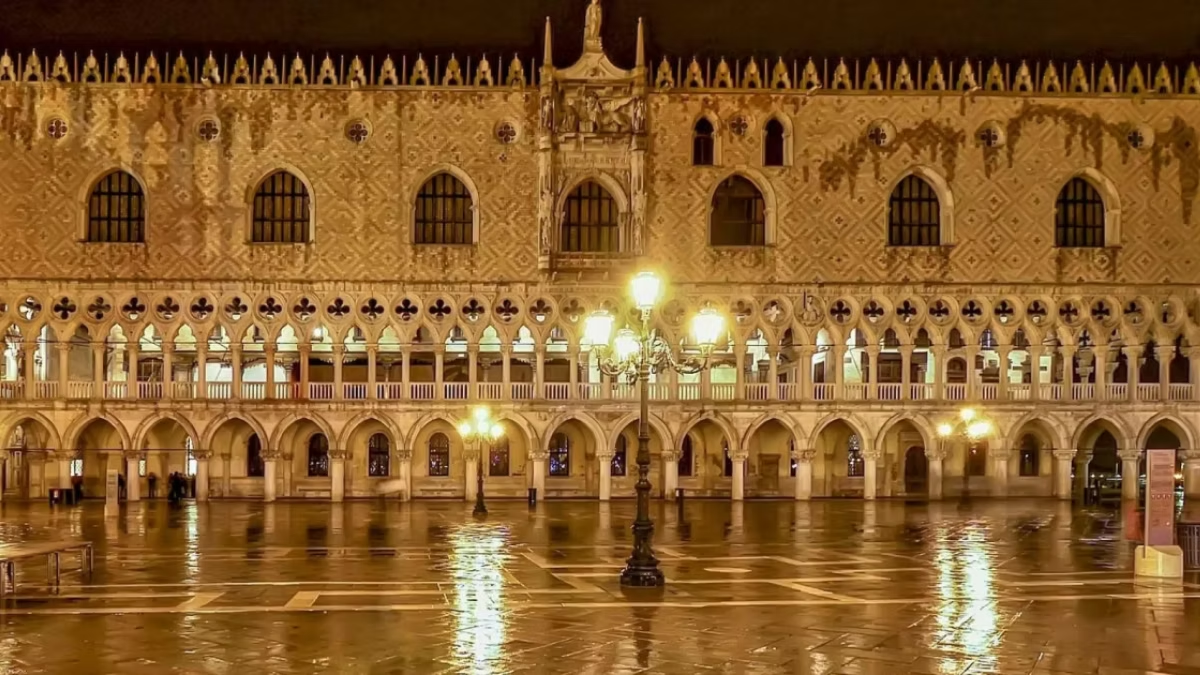
The Doge was the elected ruler of the Republic of Venice from roughly 697 AD to 1797 — a position lasting over 1,100 years and held by 120 different men. The word “doge” derives from the Latin dux (leader) and the Venetian dòxe (chief). Despite the title, the Doge was not a king — he was elected for life by the Venetian nobility through an elaborate multi-stage voting process, and his personal power was severely constrained by the Republic’s constitutional design. The last Doge was Ludovico Manin, who abdicated on 12 May 1797 when Napoleon’s forces entered Venice, ending the Republic. Most Doges were elected in old age (typically over 70), serving relatively short reigns before death triggered another election. Famous Doges include Enrico Dandolo (leader of the Fourth Crusade), Francesco Foscari, Leonardo Loredan, and Sebastiano Venier (commander at Lepanto).
Understanding what a Doge actually was — and, crucially, what a Doge wasn’t — is essential to making sense of the palace and its iconography. Too many visitors arrive assuming the Doge was a king, the palace a royal residence. The reality is more interesting: Venice was a genuine republic, and the Doge was its elected head of state, holding ceremonial primacy but severely limited personal authority. This guide covers the institution from its 8th-century origins through its 1797 end, including the famous individuals who held the office.
What Was a Doge?
The Doge was the Republic of Venice’s elected head of state — a position combining ceremonial authority, judicial primacy, and constrained executive power. Unlike European monarchs, the Doge was not hereditary, held no personal estates by virtue of office, could not leave Venice without Council permission, and operated under constant supervision of the Minor Council (six advisors) who accompanied him at virtually all public business. His real power came from his prestige, his seniority in the nobility, and his ability to influence (but not unilaterally direct) the various councils of government.
| Feature | Details |
|---|---|
| Official title | Doge (from Latin dux) |
| Term of office | For life |
| Total number of Doges | 120 (697–1797) |
| First Doge | Traditionally Paolo Lucio Anafesto (697) |
| Last Doge | Ludovico Manin (1789–1797) |
| Selection | Elected by the nobility |
| Typical age at election | Usually over 70 |
What the Doge could do
- Preside: over meetings of the Senate and Great Council
- Sign: and authorize major legislation and treaties
- Receive: foreign ambassadors in formal audience
- Command: the state’s ceremonial functions
- Represent: the Republic in official correspondence
- Exercise: substantial political influence through prestige and seniority
What the Doge could not do
- Leave Venice: without explicit Council permission
- Own foreign property: or have personal interests abroad
- Receive personal gifts: above minor token value from foreign powers
- Correspond privately: with foreign sovereigns (his mail could be opened)
- Act alone: the Minor Council (six advisors) accompanied him at nearly all official functions
- Determine policy unilaterally: all major decisions required approval from other bodies
The institutional design reflected deep Venetian suspicion of concentrated personal power. After the early centuries — when some Doges had exercised near-monarchical authority — the Republic systematically constrained the office until it became primarily symbolic and ceremonial.
The Election Process
Venice developed one of the most complex electoral procedures in history for choosing its Doge — a deliberately convoluted multi-stage process involving random selection (sortition), voting rounds, and narrow electoral colleges, specifically designed to prevent factional control. The full process involved ten rounds alternating between random drawing of balls and electoral voting, progressively narrowing from the full Great Council to a final electoral body of 41 men who then chose the new Doge. The process was extraordinarily slow — sometimes taking weeks — but was considered highly resistant to manipulation.
The 10-stage electoral process
The canonical Venetian electoral procedure (developed around the 13th century) worked roughly as follows:
- From the Great Council: (1,000+ nobles), 30 members drawn by lot
- Those 30 reduced by lot: to 9
- Those 9 elect 40 (by a 7/9 supermajority)
- Those 40 reduced by lot: to 12
- Those 12 elect 25 (by supermajority)
- Those 25 reduced by lot: to 9
- Those 9 elect 45 (by supermajority)
- Those 45 reduced by lot: to 11
- Those 11 elect 41 (by supermajority)
- Those 41 elect the Doge: (requiring 25 votes, i.e., approximately 61%)
Why this system?
The complexity served specific goals:
- Prevent dynastic concentration: no family could manipulate a random lot draw
- Prevent factional control: multiple stages required broad coalition-building
- Combine wisdom of older voters with broad input: randomness sampled the entire noble class
- Avoid corruption: too many unpredictable stages for systematic bribery
- Maintain legitimacy: the elaborate process bestowed obvious legitimacy on the outcome
The system lasted from the 13th century to the fall of the Republic in 1797 — over 500 years of institutional continuity.
The age pattern
Because the process selected experienced, senior nobles, successful candidates were typically:
- Over 70 years old: at election
- Previously held positions: as procurators of St. Mark (a common “ladder to the dogeship”)
- Military or diplomatic veterans
- Members of wealthy patrician families
- Politically experienced: in the Senate or Great Council
Election in old age meant reigns were often short — many Doges served fewer than 10 years before death. Some served much longer (Francesco Foscari, 34 years; Leonardo Loredan, 20 years).
The Life of a Doge
Despite the constraints, a Doge’s life included genuine privileges. He lived in the Doge’s Apartments on the first floor of the palace, received substantial state salary and allowances, dined with honored guests in the palace’s ceremonial dining rooms, led state processions on ceremonial occasions, and held real symbolic dignity throughout Venice. His wife was known as the Dogaressa and had her own ceremonial role. The Doge’s household included servants, guards, and personal staff. After 1486, Doges were required to reside permanently within the palace, essentially becoming constitutional residents of the state building.
Daily routine
A typical Doge’s day (during the Republic’s mature period, 16th–17th centuries):
- Morning:: Meetings with the Minor Council, handling correspondence, reviewing overnight intelligence
- Late morning:: Attendance at Senate or Collegio meetings (twice weekly for Senate, more frequently for Collegio)
- Afternoon:: Receptions of ambassadors, administrative functions, personal audiences
- Evening:: State dinners, ceremonial occasions, or private time in apartments
- Major feast days:: Leading public processions, attending Mass at St. Mark’s Basilica, ceremonial appearances
The Dogaressa
The Doge’s wife held her own ceremonial role:
- Ceremonial title and honors
- Her own staff and apartments
- Some public appearances on major occasions
- No political authority (Venice’s constitutional design excluded women from governance entirely)
Compensation
The Doge received state compensation but was also expected to bear many official expenses personally:
- State salary: substantial but not princely
- Allowances: for official entertainment
- Residence: in the palace at state expense
- Personal wealth: was assumed and often substantial (most Doges came from very wealthy patrician families)
Some Doges effectively subsidized the Republic through personal expenditure on state functions — a marker of patrician civic virtue.
Death and succession
Upon a Doge’s death:
- Ceremonial funeral: with state honors
- Brief formal mourning period: (but not citywide grief: “the Republic never dies”)
- Temporary administration: by senior officials
- Electoral process begins immediately: for successor
- Funeral monument: typically placed in a major Venetian church, not in the palace itself
Many Doge funerary monuments survive in Venetian churches, particularly Santi Giovanni e Paolo (the traditional Doge burial church) and the Frari.
Famous Doges
Several Doges are particularly historically significant — either for their roles in defining Venetian history, their artistic patronage, or their dramatic stories. Among the most important: Enrico Dandolo (1192–1205, blind but led the Fourth Crusade at age 90+), Francesco Foscari (1423–1457, longest reign at 34 years, oversaw expansion onto the mainland), Leonardo Loredan (1501–1521, led Venice through the League of Cambrai crisis, famously portrayed by Bellini), Sebastiano Venier (1577–1578, commanded at the Battle of Lepanto), Marin Falier (1354–1355, executed for treason, memory erased from the Chamber of the Great Council), and Ludovico Manin (1789–1797, the last Doge).
Enrico Dandolo (1192–1205)
- Elected at age ~85, blind: by the time he took office
- Led the Fourth Crusade: (1202–1204)
- Orchestrated the controversial Crusade diversion to Constantinople: in 1204
- Conquered Constantinople and established Venetian dominion over much of the Byzantine Empire
- Died in Constantinople in 1205 at approximately age 98
- One of the most consequential Doges in the Republic’s expansion into a Mediterranean empire
Francesco Foscari (1423–1457)
- Longest-reigning Doge at 34 years
- Led Venetian expansion into the Italian mainland (terraferma)
- His kneeling figure appears above the Porta della Carta (19th-century replacement of original)
- Suffered the tragedy of his son Jacopo being repeatedly exiled on treason charges
- Ultimately forced to abdicate in his final illness
- Subject of Byron’s play The Two Foscari and Verdi’s opera I due Foscari
Marin Falier (1354–1355)
- Elected Doge in old age (~75)
- Conspired with supporters to overthrow the Great Council: and install himself as absolute ruler
- Conspiracy discovered; executed by beheading at the top of the Giants’ Staircase in April 1355
- Memory erased by Senate decree: the black curtain: in the Chamber of the Great Council covers where his portrait would appear
- Subject of Byron’s play Marino Faliero, Donizetti’s opera, and Delacroix’s painting
- His dramatic fate became iconic of Venetian constitutional discipline
Leonardo Loredan (1501–1521)
- Led Venice through the War of the League of Cambrai: (1508–1516)
- Survived the coalition’s attempt to destroy the Republic
- Famously portrayed by Giovanni Bellini: (portrait now in London’s National Gallery)
- Featured as protagonist of Palma il Giovane’s “Allegory of Victory”: in the Sala del Senato
- One of the most artistically memorialized Doges
Sebastiano Venier (1577–1578)
- Commander of Venetian forces at the Battle of Lepanto: (7 October 1571)
- Age ~75 at Lepanto; ~80 at election as Doge
- Subject of Veronese’s Votive Portrait of Doge Sebastiano Venier: (1581–1582) in the Sala del Collegio
- Short reign but historically significant for the Lepanto connection
- His armour is displayed in the Armoury
Ludovico Manin (1789–1797)
- The last Doge of Venice
- Forced to abdicate on 12 May 1797: when Napoleon’s forces entered Venice
- Famously said “This is the last time I wear it” while removing his ducal cap (corno)
- Died in Venice in 1802 as a private citizen under French/Austrian occupation
- His abdication ended 1,100 years of Venetian self-government
Other notable Doges
- Paolo Lucio Anafesto: (697): traditionally the first Doge
- Doge Pietro Ziani: (1205–1229): expanded Venetian maritime empire
- Doge Andrea Contarini: (1368–1382): led Venice to victory in the War of Chioggia (1378–1381)
- Doge Antonio Grimani: (1521–1523): portrayed by Titian
- Doge Marino Grimani: (1595–1605): commissioned the Bridge of Sighs
- Doge Francesco Morosini: (1688–1694): last Doge-general, famous for Ottoman campaigns including the 1687 bombardment of the Parthenon in Athens
The Institution’s Evolution
Early period (697–1172)
Early Doges held near-monarchical authority. Some became effective autocrats. Violent politics — several Doges were murdered, deposed, or exiled. The institution hadn’t yet been constrained by the mature constitutional structure.
Constitutional period (1172–1297)
Gradual development of checks on ducal power:
- Promissione Ducale: a contractual oath each new Doge swore, increasingly restrictive
- Minor Council: six advisors who accompanied the Doge constantly
- Great Council: codified
- Senate: developed
- Council of Ten: established (1310) as security/intelligence council
By the end of this period, the Doge’s personal authority was substantially constrained.
Mature republic (1297–1797)
The Serrata del Maggior Consiglio (1297) effectively closed the patrician class, creating a hereditary ruling nobility. Over the following five centuries:
- The Doge became increasingly ceremonial
- Real power lay in the various councils: (Senate, Great Council, Council of Ten, Collegio)
- The Doge’s role became constitutional-symbolic
- Most Doges were highly respected but wielded relatively limited personal power
Decline and end (17th–18th centuries)
As Venice declined as a Mediterranean power:
- Doges increasingly represented nostalgic continuity: rather than active leadership
- The Republic became less able to project power
- The institution’s ceremonial character intensified
- Ludovico Manin’s 1797 abdication: ended the institution
Iconography of the Doge
Several visual elements identify the Doge in Venetian art and decoration:
The Corno
The Doge’s distinctive horn-shaped cap (corno ducale):
- Pointed at the back, rising peak
- Made of richly decorated fabric
- Often gold-embroidered and gem-studded
- Unique to the Venetian Doge (no equivalent in other Italian states)
The Ducal Robes
- Ermine-trimmed: white and gold
- Long robes: reflecting ceremonial dignity
- Worn with the corno
The Lion of St. Mark
Often depicted near or alongside the Doge in formal portraits, representing the Republic he served. Crucially, the Doge is typically shown in humble posture before the Lion — reinforcing that he served the state, not the reverse.
Frequently Asked Questions
Was the Doge a king?
No. The Doge was the elected head of state of a republic — distinct from a hereditary monarch. His personal authority was severely constrained; Venice was structurally a republic throughout its history.
How long did a Doge serve?
For life. However, because Doges were typically elected in old age (often over 70), many served relatively short reigns before death. The average reign was around 10–15 years; some served 1–3 years, others 20–30 years.
How was the Doge elected?
Through an elaborate 10-stage process combining random selection (sortition) and voting rounds, progressively narrowing from the full Great Council to a final electoral body of 41 who chose the Doge by supermajority.
Who was the first Doge?
Traditionally Paolo Lucio Anafesto, elected in 697 AD. However, historical records for the earliest Doges are uncertain, and some historians question whether Anafesto was truly the first.
Who was the last Doge?
Ludovico Manin (1789–1797), who abdicated on 12 May 1797 when Napoleon’s forces entered Venice.
How many Doges were there total?
120 Doges over 1,100 years (697–1797) — reflecting the long tenures of some, short tenures of others, and occasional gaps between elections.
What was the Doge’s salary?
Substantial but varied by era. The Doge received a state stipend plus allowances for official entertainment, residence in the palace at state expense, and various ceremonial privileges. Many Doges were personally wealthy and sometimes contributed to state expenses from personal funds.
Why is there a black curtain instead of a Doge portrait?
That’s the position for Marin Falier, the 55th Doge, executed in 1355 for attempting to overthrow the Republic. The Senate ordered his memory erased — no portrait, his name struck from official records. The black curtain serves as both memorial and warning.
Did Doges live in the palace?
Yes, particularly after 1486 when residence became a formal requirement. The Doge’s Apartments on the palace’s first floor housed the Doge and his household.
Who elects the Doge today?
No one — the institution ended in 1797. Venice has had no Doge for over two centuries.
Are any Doge artifacts on display?
Yes. The 76 Doge portraits in the Chamber of the Great Council, various ducal armour in the Armoury, Doge Antonio Grimani’s portrait by Titian, and the Doge Francesco Foscari kneeling statue above the Porta della Carta (19th-century replacement).
How do I find out about specific Doges?
The palace’s standard tour mentions major Doges. For comprehensive biography, academic sources like the Oxford Dictionary of Renaissance Italy and specialized Venetian histories provide detail. The MUVE app audio guide covers key figures.
