

Golden Staircase (Scala d’Oro): Complete Guide to the Doge’s Palace Ceremonial Entrance
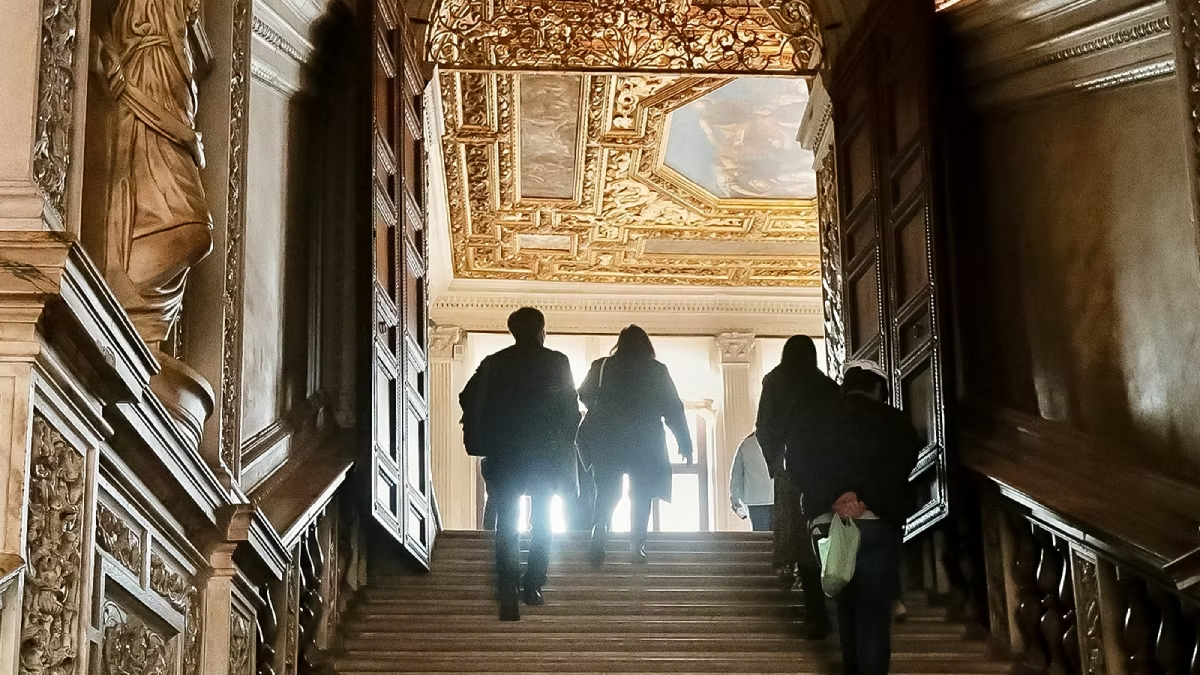
The Scala d’Oro (Golden Staircase) is the ornate ceremonial staircase leading from the ground floor of the Doge’s Palace to the first-floor Doge’s Apartments and the second-floor state rooms. Designed by Jacopo Sansovino starting in 1538 and completed in 1577, the staircase takes its name from the elaborate gold-leaf stucco decoration covering the vaulted ceiling by Alessandro Vittoria. The staircase functioned as the ceremonial route for newly elected Doges, foreign ambassadors, and senior officials entering the palace’s formal rooms. Today it’s the main visitor route up from the ground floor. Plan 5–10 minutes for the ascent including photography.
The Scala d’Oro is the transition point in a Doge’s Palace visit — the moment you leave the practical, administrative ground floor and enter the palace’s truly magnificent spaces. Walking up the staircase, the decoration becomes progressively more elaborate, climaxing in the gold-leaf stucco vault overhead. Historically, this was a deliberate experience: the staircase was designed as a symbolic ascent from everyday Venice into the rarefied world of ducal government. This guide covers the design, the decoration, the symbolism, and how to appreciate the staircase on your visit.
Design and Construction
The staircase was commissioned in 1538 to provide a dignified ceremonial route from the ground-floor courtyard to the palace’s residential and state-room floors. Architectural design by Jacopo Sansovino (Venice’s leading Renaissance architect of the 16th century), with completion by Scarpagnino after Sansovino’s death in 1570. The staircase was finished in 1577 — just months before the catastrophic fire that damaged nearby sections of the palace. The gold-leaf stucco decoration that gives the staircase its name was executed by Alessandro Vittoria (Sansovino’s pupil) and collaborators between 1555 and 1559.
| Feature | Details |
|---|---|
| Commissioned | 1538 |
| Completed | 1577 |
| Architect | Jacopo Sansovino (design); Scarpagnino (completion) |
| Stucco decorator | Alessandro Vittoria and collaborators |
| Stucco work period | 1555–1559 |
| Function | Ceremonial ascent to ducal floors |
| Current use | Main visitor route up from ground floor |
| Typical visit time | 5–10 minutes |
Why it was built
Before the Scala d’Oro, access to the upper floors relied on various older staircases within the palace — none of which presented the dignified ceremonial route that the Republic wanted for incoming doges, ambassadors, and senior officials. The Great Council commissioned the new staircase specifically to provide a visually impressive formal entrance to the residential and state-room floors, reinforcing the palace’s ceremonial grandeur.
The staircase’s placement — inside the palace’s north wing, ascending directly from the main courtyard — ensured that the route from the Porta della Carta (palace main entrance) through the courtyard, up the Giants’ Staircase (Scala dei Giganti), and then up the Scala d’Oro created a continuous ceremonial axis from the public Piazza San Marco into the heart of Venetian government.
The Architect: Jacopo Sansovino
Jacopo Sansovino (1486–1570) was Venice’s dominant architect and sculptor for much of the 16th century. Arrived in Venice in 1527 after fleeing the Sack of Rome; appointed Proto (chief architect) of the Procurators of St. Mark in 1529, a position he held for 40 years. Major Venice works include:
- Biblioteca Marciana: the library facing the palace across the Piazzetta
- Loggetta del Campanile: small classical structure at the base of the bell tower
- Zecca: the Venetian mint
- Scala d’Oro: the palace’s ceremonial staircase (begun 1538, completed by Scarpagnino)
- Giants’ Staircase statues: Mars and Neptune (1554–1567) in the palace courtyard
The Scala d’Oro represents Sansovino’s mature style — Renaissance classical architectural principles applied to a fundamentally ceremonial Venetian program.
The Gold-Leaf Stucco Decoration
The staircase’s distinctive appearance comes from the elaborate stucco decoration of the vaulted ceiling — relief sculpture covered in 24-karat gold leaf creating an overwhelming visual impression of opulence. The stucco work was executed primarily by Alessandro Vittoria (a pupil of Sansovino) and his collaborators between 1555 and 1559. The program includes mythological figures, allegorical representations of Venetian virtues, coats of arms of noble families, and decorative patterns. It’s the single most elaborate example of decorative stucco work in the palace.
Alessandro Vittoria
Alessandro Vittoria (1525–1608) was Sansovino’s most important pupil and one of the 16th century’s leading Venetian sculptors. Works across Venice include:
- Scala d’Oro stucco decoration
- Sculptures in several churches including Frari and San Zaccaria
- The bronze doors of St. Mark’s Library
- Numerous portrait busts in the Venetian Renaissance style
The Scala d’Oro stuccoes were Vittoria’s first major Venice commission and established his reputation.
The decorative program
Looking up at the vault as you climb, you see:
- Central panels: with figurative scenes: Venetian mythological history, allegorical virtues
- Framing patterns: of classical architectural ornament
- Relief figures: of allegorical personifications
- Family coats of arms: of noble families who contributed to the construction
- Decorative borders: with fruit, flowers, and classical motifs
The gold leaf catches light differently depending on the time of day and angle of viewing. Morning light illuminates specific sections; afternoon light others. Most visitors find photographs don’t capture the full effect.
Iconographic program
The stuccoes aren’t purely decorative — they form a coherent iconographic program celebrating Venice. Key themes:
- Venetian maritime power: allegorical figures of the sea
- Civic virtues: Justice, Prudence, Fortitude, Temperance
- Trade and abundance: personifications of Venetian commercial success
- Military glory: victories celebrated through allegorical figures
The overall message reinforces Venice’s self-image as a divinely favoured commercial and military republic — themes elaborated further in the state rooms upstairs.
The Floor
The staircase floor features a geometric patterned design in marble and stone that creates a three-dimensional trompe-l’œil effect when viewed from certain angles. If you look down the stairs while ascending — or up while descending — the floor pattern appears to have depth and movement. This is an intentional Renaissance design choice paralleling the rich ceiling decoration: the entire staircase was designed as a sensory experience.
Look down at the floor as you climb — the geometric inlay work often gets overlooked in favor of the ceiling, but it’s part of the same integrated design program.
Symbolic and Ceremonial Function
The Scala d’Oro was the ceremonial route for newly elected Doges ascending to begin their reign, foreign ambassadors being formally received, and Venetian officials entering for high-level meetings. The staircase functioned as a liminal space — a physical and symbolic transition from everyday Venice into the rarefied realm of ducal governance. The progressively more elaborate decoration as one ascended was deliberate psychological staging, impressing visitors with Venetian grandeur before they reached the state rooms.
Who used it historically
- Newly elected Doges: ascending to their inauguration in the Chamber of the Great Council
- Foreign ambassadors: walking up to be received in the Sala del Collegio
- Senior Venetian officials: attending Senate or Great Council sessions
- Invited foreign dignitaries: visiting heads of state, papal legates, major figures
- NOT used by: ordinary Venetians, lower officials, servants (separate staircases existed for these)
The inauguration ritual
When a new Doge was elected (through an elaborate multi-day voting process), he was publicly crowned at the top of the Giants’ Staircase (in the courtyard) with the crown of office. He then processed up the Scala d’Oro to the state rooms where he would take the ducal oath before the Maggior Consiglio. The entire ceremonial ascent — courtyard to Giants’ Staircase to Scala d’Oro to Chamber of the Great Council — was choreographed to impress both the Doge himself and witnesses of the ceremony.
Position in the Visitor Route
The Scala d’Oro is the main ascent route from the ground floor to the first-floor Doge’s Apartments. Visitors reach it after entering the palace, passing through the courtyard, and briefly visiting the Museo dell’Opera on the ground floor. Ascending the staircase typically takes 3–5 minutes of actual walking, plus additional time if you stop to photograph or study the ceiling. After reaching the top, you enter the Sala degli Scarlatti — the first of the Doge’s Apartments. The staircase has an adjacent elevator for accessible visitors.
Standard visit sequence:
- Enter at Porta del Frumento
- Courtyard + Scala dei Giganti (Giants’ Staircase): external
- Museo dell’Opera
- Scala d’Oro: you ascend here
- Sala degli Scarlatti (first apartment room)
- Continue through the Doge’s Apartments
- Ascend again to the second floor via internal staircase
- State rooms sequence
The staircase is physically demanding — it’s steep and has uneven Renaissance-era steps. Visitors with mobility challenges should use the adjacent elevator (ask staff on arrival).
See Doge’s Palace Map & Floor Plan for the full building layout.
How to Look at It Properly
Most visitors rush up the staircase, treating it as transit rather than destination. The staircase genuinely rewards slowing down:
Recommended approach
- Stop halfway up: the best overall view of the vault
- Look up at the central panels: the main figurative scenes
- Notice the gold leaf variation: catches light differently depending on angle
- Study the architectural frame: the classical proportions of Sansovino’s design
- Look at the floor: three-dimensional pattern visible from certain angles
- Photograph the vault: wide-angle shots work best; no flash needed (overhead lighting is adequate)
Photography tips
- Wide angle essential: standard phone lens struggles to capture the vault
- Stop in the middle of the flight: best vantage for full-ceiling shots
- Don’t block other visitors: the staircase is narrow and crowded
- Morning light: through the small upper window creates the best illumination
- Avoid crowds: try to photograph when no tour group is ascending
Historical Timeline
Medieval predecessor staircases
Before Sansovino’s Scala d’Oro, various staircases connected the palace’s floors — none architecturally distinguished. The expansion of the Republic’s ceremonial needs in the 15th–16th centuries made the existing staircases inadequate.
Commission and design (1538–1554)
Sansovino was commissioned to design the new staircase in 1538. Progress was slow due to other palace projects, funding issues, and Sansovino’s simultaneous work on multiple Venice commissions.
Stucco decoration (1555–1559)
Alessandro Vittoria’s stucco program ran for approximately four years, creating the gold-leaf vault that gives the staircase its name. This was executed before the architectural work was entirely complete — a compressed schedule reflecting the Republic’s desire to have the staircase ready for ceremonial use.
Completion (1577)
The full staircase including architectural details was completed in 1577, under Scarpagnino after Sansovino’s death in 1570. Finishing touches concluded just months before the December 1577 fire that destroyed sections of the nearby Chamber of the Great Council.
Restoration campaigns
The staircase has undergone multiple restoration campaigns over the centuries, most recently in the early 2020s. LED lighting installations are designed to illuminate the gold-leaf stucco without damaging the historic materials.
Frequently Asked Questions
What is the Scala d’Oro?
The ornate ceremonial staircase leading from the ground floor of the Doge’s Palace to the upper residential and state-room floors. Designed by Jacopo Sansovino in 1538, completed 1577. “Scala d’Oro” means “Golden Staircase” — named for the gold-leaf stucco decoration of the vaulted ceiling.
Why is it called the Golden Staircase?
For the elaborate gold-leaf stucco decoration covering the vaulted ceiling — executed by Alessandro Vittoria and collaborators in 1555–1559.
Who designed it?
Architectural design by Jacopo Sansovino (Venice’s leading 16th-century architect). Stucco decoration by Alessandro Vittoria. Final completion by Scarpagnino after Sansovino’s death in 1570.
When was it built?
Commissioned 1538, stucco decoration 1555–1559, fully completed 1577.
How long does it take to climb?
3–5 minutes of actual walking, plus however long you spend looking at the decoration. Most visitors spend 5–10 minutes total including photography.
Is it accessible to wheelchair users?
No, not directly — the staircase has steep Renaissance-era steps. However, an adjacent elevator is available for accessible visitors. Ask staff for elevator access on arrival. See Doge’s Palace Accessibility Guide.
Is it safe to climb?
Yes, the staircase is structurally sound and well-lit. The steps are steep and occasionally uneven — hold the handrail. Visitors with balance issues should take it slowly or use the elevator.
Who historically used this staircase?
Newly elected Doges, foreign ambassadors, Venetian state officials, and invited dignitaries. Ordinary Venetians and lower officials used separate stairs within the palace.
Can I photograph the ceiling?
Yes, without flash. Phone cameras work well despite moderate lighting. Wide-angle lenses capture more of the vault.
Does it lead directly to the Chamber of the Great Council?
Not directly. The Scala d’Oro leads to the first-floor Doge’s Apartments. From there, an internal staircase (less elaborate) leads up to the second-floor state rooms, ultimately ending at the Chamber of the Great Council.
Is there anything to see on the floor?
Yes — a geometric marble-and-stone pattern that creates a three-dimensional visual effect when viewed from certain angles. Often overlooked in favor of the ceiling.
How does this compare to the Giants’ Staircase?
The Scala dei Giganti (Giants’ Staircase) is the external staircase in the courtyard, used for the Doge’s public coronation ceremony. The Scala d’Oro is the internal ceremonial staircase for ascending to the state rooms. Both were used sequentially during major ducal occasions.
