

Bridge of Sighs & New Prisons: Complete Guide to Venice’s Most Famous Bridge
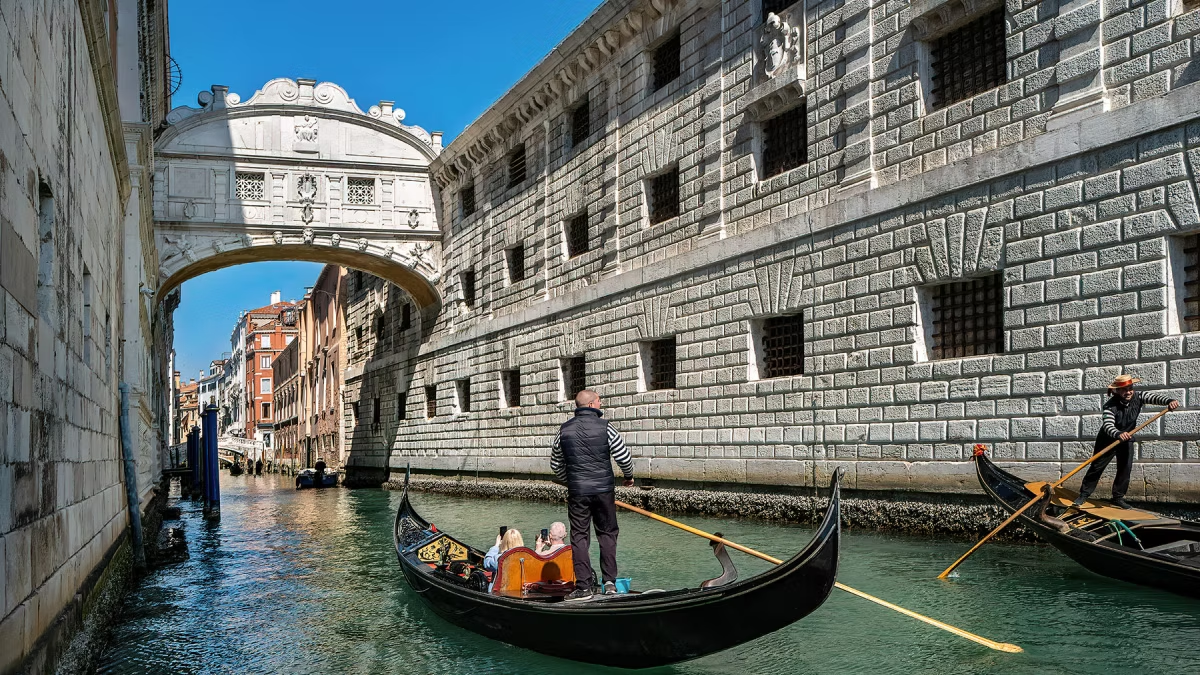
The Bridge of Sighs (Ponte dei Sospiri) is the famous enclosed white Istrian limestone bridge connecting the Doge’s Palace to the New Prisons (Prigioni Nuove) across the Rio di Palazzo canal. Built between 1600 and 1603 by architect Antonio Contin (nephew of Antonio da Ponte, who designed the Rialto Bridge), the bridge has two separate parallel corridors — one for prisoners going from interrogation to their cells, one for returning. Its romantic name was coined by Lord Byron in 1812 via his poem Childe Harold’s Pilgrimage, based on the notion that condemned prisoners sighed at their final view of Venice through the small stone-barred windows. The most famous escape was Giacomo Casanova’s 1756 flight from the Piombi — the attic prisons above the palace, not the New Prisons below. Inside-bridge viewing requires a palace ticket; outside viewing is free.
The Bridge of Sighs is the single most photographed bridge in Venice and one of the most recognized in the world — yet the romantic name misrepresents the building’s actual history. It wasn’t primarily a place of dramatic sorrowful transit. It was a practical 17th-century judicial infrastructure connecting the Republic’s courtrooms to its newly-built prison facility. The sighing legend is a 19th-century romantic overlay that happens to have stuck. This guide covers the bridge’s construction, its prison complex, Casanova’s famous escape, and how to see the bridge at its best.
The Bridge Itself
The Bridge of Sighs is a single-arch enclosed bridge built entirely of white Istrian limestone in a Baroque style. Approximately 11 meters long, it spans the Rio di Palazzo canal at second-floor height between the Doge’s Palace and the Prigioni Nuove. The exterior features refined Baroque decorations including the coat of arms of Doge Marino Grimani (who commissioned it). The interior contains two separate narrow corridors — one for outbound prisoner transit, one for return — each with small windows covered by perforated stone grilles. Only fragments of light and sliced views of the lagoon come through the windows, accentuating the sense of isolation.
| Feature | Details |
|---|---|
| Built | 1600–1603 |
| Commissioned by | Doge Marino Grimani |
| Architect | Antonio Contin |
| Material | White Istrian limestone |
| Length | ~11 meters |
| Spans | Rio di Palazzo canal |
| Structure | Single arch, fully enclosed |
| Interior | Two separate parallel corridors |
| Windows | Small, with perforated stone grilles |
The architect
Antonio Contin was a significant Venetian architect working at the turn of the 17th century. His uncle Antonio da Ponte had designed the Rialto Bridge (completed 1591) — the main bridge across the Grand Canal. The family connection matters because both bridges share distinctive Venetian architectural DNA: single-span arches in white Istrian stone, clean Baroque detailing, practical engineering solving specific civic problems.
The commissioning Doge
Doge Marino Grimani (reigned 1595–1605) commissioned the bridge. The Grimani family coat of arms appears prominently on the exterior — an unusual feature for the time, as most ducal commissions avoided personal family branding on public works. Grimani belonged to one of Venice’s most powerful patrician families.
The two corridors
The bridge’s interior is not a single passage but two parallel corridors separated by a central stone wall. This design served judicial procedure:
- Outbound corridor: prisoner walked from the palace’s interrogation rooms toward the New Prisons
- Inbound corridor: prisoner returning to court for further proceedings walked back
The separation prevented interaction between prisoners at different stages of judicial processing.
The Name: Lord Byron’s Invention
Despite its worldwide fame, the name “Bridge of Sighs” is not original — during the Republic, the bridge was simply called the Ponte del Palazzo (Palace Bridge) or similar practical names. Lord Byron invented the romantic appellation in his 1812 poem Childe Harold’s Pilgrimage, writing “I stood in Venice on the Bridge of Sighs; A palace and a prison on each hand.” The poem’s opening line imagined condemned prisoners sighing at their last glimpse of Venice through the bridge’s small windows. The name stuck globally because Byron was the most read English-language poet of his era.
The Byron quote
The opening lines of Childe Harold’s Pilgrimage Canto IV (1818):
I stood in Venice on the Bridge of Sighs; / A palace and a prison on each hand: / I saw from out the wave her structures rise / As from the stroke of the enchanter’s wand.
This was Byron’s first encounter with Venice during his extended Italian stay. The romantic framing — imagined prisoners sighing at Venetian beauty — caught the 19th-century European imagination. By the mid-19th century, “Bridge of Sighs” was the standard international name. Translations into Italian (Ponte dei Sospiri), French (Pont des Soupirs), and other languages followed Byron’s English naming.
The reality
The name has no basis in Republic-era records. By the time the bridge was built (1600–1603), Venice’s judicial system had become relatively systematic and procedural. Prisoners crossing the bridge were:
- Typically low-to-mid-level offenders: being moved between interrogation and cells
- Not condemned to immediate death (executions were rare and handled separately)
- Processed through what by contemporary standards was one of Europe’s more regularized judicial systems
The dramatic “last view of Venice” framing applies more to the earlier “Pozzi” and “Piombi” cells within the palace itself than to the post-1603 New Prisons — where many prisoners served time and were eventually released rather than executed.
The New Prisons (Prigioni Nuove)
The Prigioni Nuove (“New Prisons”) were built across the Rio di Palazzo from the Doge’s Palace starting in 1563 and completed around 1614. They replaced earlier prison cells within the palace itself — the damp ground-floor “Pozzi” (Wells) and the attic “Piombi” (Leads) — which had become overcrowded and inhumane. The New Prisons represent one of the earliest purpose-built prison buildings in the world, separating detention facilities from government offices. Still standing and part of the Doge’s Palace museum tour. Approximately 40 cells across multiple floors.
Historical significance
The Prigioni Nuove are considered among the earliest purpose-built prison buildings in European history. Most pre-17th-century imprisonment used adapted spaces — castle dungeons, ground floors of government buildings, fortress cellars. Venice’s decision to build a dedicated prison structure, physically separated from the government palace but connected by the Bridge of Sighs, was a meaningful institutional innovation.
Layout and conditions
The New Prisons contained approximately 40 cells across several floors:
- Ground-floor cells: darker, damper, for lower-status prisoners or initial detention
- Upper-floor cells: relatively more humane, for longer-term prisoners
- Interrogation rooms: connected to the bridge corridor
- Administrative offices: for prison staff
- Courtyards: allowing some prisoner exercise
Conditions varied significantly by cell location. Upper cells had some natural light; ground-floor cells had almost none. Prisoners sometimes inscribed their names, dates, and messages on cell walls — some of this graffiti survives and is visible on the modern tour.
Famous prisoners
Historical inmates of the Venetian prison system (the Pozzi and Piombi within the palace, and later the New Prisons) included:
- Giacomo Casanova: (1755–1756): in the Piombi (palace attic), not the New Prisons
- Giordano Bruno: famously held in Venice before transfer to Rome and execution (1600)
- Various political prisoners: nobles accused of conspiracy, foreign agents, suspected heretics
- Common criminals: thieves, murderers, fraudsters
Casanova’s Escape from the Piombi (1755–1756)
Giacomo Casanova (1725–1798) — Venetian adventurer, memoirist, and cultural figure — was imprisoned in the Piombi (the “Leaden” attic cells inside the Doge’s Palace) in 1755 on charges of atheism, occultism, and “affront to religion.” After 15 months of detention, he escaped on the night of 31 October 1756 — one of the most famous escapes in European criminal history. The escape involved cutting through the lead roof, moving across the palace’s upper levels, and ultimately walking out through a main entrance disguised as a nobleman. Important clarification: Casanova was never actually in the New Prisons — the Piombi were in the palace attic, above the ceremonial rooms, not across the Bridge of Sighs.
The Piombi cells
The Piombi (“Leads”) were cells in the palace attic, named for the lead roofing above them. This metal roofing created brutal temperature conditions:
- Summer:: cells heated to oven-like temperatures under the lead-covered roof
- Winter:: cells froze because of the same metal’s thermal conductivity
- Accessed via steep narrow attic stairs: very difficult to escape from by conventional means
The Piombi were specifically used for political prisoners, nobles, and high-status offenders — not common criminals. Casanova’s imprisonment there reflected his status as a minor noble and cultural figure (rather than a major political threat).
The escape itself
Casanova’s escape on 31 October – 1 November 1756 involved:
- Cutting through the ceiling: of his cell with a makeshift iron bar obtained over months
- Climbing through the attic space: above the cell ceiling
- Moving across the lead roof: at risk of detection and fatal fall
- Re-entering the palace: through an unlocked attic window
- Walking through the palace: disguised in normal clothing he had maintained
- Exiting through a main door: as if departing normal business
- Fleeing Venice: by gondola to the mainland
The entire escape took several hours of careful movement through the sleeping palace. Casanova documented the escape in detail in his memoirs, published posthumously as Histoire de ma fuite des prisons de la République de Venise qu’on appelle les Plombs (“History of my Flight from the Prisons of the Venetian Republic known as the Leads”).
Visit considerations
The Piombi cells are visited only on the Secret Itineraries Tour — they’re not part of the standard visitor route. See Secret Itineraries Tour: Complete Guide for booking information.
The New Prisons (which visitors see on the standard tour after crossing the Bridge of Sighs) are not where Casanova was held. This is a common visitor confusion.
The Earlier Prisons: Pozzi and Piombi
Before the New Prisons were built (1563–1614), Venetian prisoners were held in two sections within the palace itself. The Pozzi (“Wells”) were ground-floor cells at canal-water level — damp, dark, and often flooded during high tides. Reserved primarily for common criminals and lower-status prisoners. The Piombi (“Leads”) were attic cells under the palace’s lead roof — better lit than the Pozzi but subject to extreme temperature swings. Used for political prisoners and higher-status detainees. Both systems were considered inhumane even by 16th-century standards, driving the decision to build the New Prisons as a replacement.
The Pozzi
- Location:: Ground floor of the Doge’s Palace, at canal-water level
- Conditions:: Dark, damp, sometimes flooded at high tide
- Primary use:: Common criminals, awaiting-trial detainees, short-term imprisonment
- Origin of name: “Pozzi” = “wells”: cells were below water level in places
- Status today:: Accessible on the Secret Itineraries Tour; some cells preserved
The Piombi
- Location:: Attic story of the Doge’s Palace, directly beneath the lead roof
- Conditions:: Extreme temperature variation (hot summers, cold winters)
- Primary use:: Political prisoners, nobles, cultural figures, religious offenders
- Origin of name: “Piombi” = “leads”: referring to the lead roofing
- Status today:: Accessible on the Secret Itineraries Tour; where Casanova was held
Both systems were abandoned or repurposed after the New Prisons opened, though some cells remained in use for specific cases into the 18th century.
Crossing the Bridge Today
Modern visitors cross the Bridge of Sighs as the dramatic conclusion to the standard palace visit. After viewing the Chamber of the Great Council, the route descends to the bridge and across to the New Prisons for a brief tour of original cells, then exits back to the palace courtyard. The entire Bridge + Prisons section takes approximately 15–20 minutes. Inside the bridge, the two small stone-grille windows offer the same narrow sliced views of Venice that prisoners would have seen. Photography is permitted but the small windows limit what you can capture.
The modern crossing experience
The crossing takes only 30 seconds to a minute of actual walking. The bridge interior is:
- Narrow: two parallel corridors, each about 1.5 meters wide
- Low-ceilinged: designed for practical transit, not comfort
- Dim: minimal light through small grilled windows
- Cool in summer, cold in winter: stone construction with limited airflow
The view from inside
The two small windows on each side offer restricted views:
- One view: toward San Giorgio Maggiore and the outer lagoon
- Other view: toward the Venice shoreline and boats in the canal
The perforated stone grilles break the view into small geometric segments — a deliberate design choice (partially for prisoner security, partially aesthetic) that creates the fragmented “last view of Venice” that became the bridge’s romantic hook.
After the bridge
On the New Prisons side, visitors walk through:
- A preserved cell: (often multiple)
- Connecting corridors: with original stonework
- Wall graffiti: carved by past prisoners (where visible)
- Exit stairs: leading back toward the palace courtyard
Viewing the Bridge from Outside
Two main external viewpoints show the Bridge of Sighs at its best — and both are free and publicly accessible without a palace ticket. The Ponte della Paglia is the main tourist bridge directly in front of the Doge’s Palace façade; it’s typically crowded but offers the classic picture-postcard view. The Ponte della Canonica is a less-crowded bridge on the opposite side, offering an equivalent view. A gondola ride under the Bridge of Sighs costs €80–120 for 30 minutes and passes directly beneath — the most photogenic but most expensive option.
Ponte della Paglia (the standard view)
- Location:: The public bridge directly in front of the palace, where Riva degli Schiavoni crosses the Rio di Palazzo
- View:: Direct frontal shot of the Bridge of Sighs across the canal
- Crowds:: Heavy almost all day: expect 20–50 tourists at any given time
- Best time:: Early morning (before 09:00) or late evening (after 19:00) for fewer people
- Lighting:: Afternoon light illuminates the bridge façade best
Ponte della Canonica (the alternative view)
- Location:: Behind the palace, on the opposite side of the Rio di Palazzo
- View:: Mirror-image of the Ponte della Paglia view, looking at the bridge from behind
- Crowds:: Significantly lighter than Ponte della Paglia
- Best time:: Flexibility, less weather-dependent
- Access: 5 minutes’ walk around the palace to reach
Gondola under the bridge
- Cost: €80–120 per gondola for a 30-minute ride (typically 6 passengers)
- Duration:: About 30 seconds actually passing under the Bridge of Sighs
- Romantic tradition:: Lovers who kiss while passing under the bridge at sunset are said to enjoy eternal love
- Recommendation:: If doing a gondola ride anyway, include the Bridge of Sighs route. Don’t book specifically for this: the brief passage doesn’t justify the cost alone
Restoration Work
The bridge underwent a major three-year restoration from 2008 to 2011, costing approximately €2.8 million. Problems addressed:
- Erosion of exterior stonework: from water damage
- Structural concerns: after pieces of stone had fallen into the canal below
- Cleaning accumulated grime: from centuries of weathering
- Interior repairs: to corridor surfaces
Funding was controversial — the restoration was partially financed by prominent advertisements placed on scaffolding around the bridge during work, which many Venice residents considered aesthetically damaging. Since restoration completion, the bridge’s original white Istrian stone color has been fully visible again.
Position in the Visitor Route
The Bridge of Sighs + New Prisons section comes at the end of the standard palace visit, after the Chamber of the Great Council. Visitors descend from the second floor, cross the bridge, tour the prisons, and exit back to the ground floor courtyard. Total time for this section: 15–20 minutes. For wheelchair users, note that the bridge is stairs-only and cannot be accessed by wheelchair — see the dedicated accessibility guidance.
Sequence:
- Exit Chamber of the Great Council
- Descend internal stairs
- Enter Bridge of Sighs corridor
- Cross to New Prisons
- Tour preserved cells
- Exit via stairs back to the ground floor courtyard
- Return through courtyard to palace exit
See Doge’s Palace Map & Floor Plan for the full layout and Doge’s Palace Accessibility Guide for accessible-route alternatives.
Frequently Asked Questions
Can I walk across the Bridge of Sighs?
Yes, but only inside the palace as part of your visit. The bridge is not accessible from outside — you must enter the palace with a valid ticket, then cross the bridge near the end of your visit.
Is Casanova’s cell on the bridge tour?
No. Casanova was held in the Piombi (palace attic cells), not in the New Prisons below. The Piombi are visited only on the Secret Itineraries Tour. See Secret Itineraries Tour: Complete Guide.
Who built the Bridge of Sighs?
Antonio Contin, nephew of Antonio da Ponte (designer of the Rialto Bridge), built it between 1600 and 1603. Commissioned by Doge Marino Grimani.
Why is it called the Bridge of Sighs?
The name was coined by Lord Byron in his 1812 poem Childe Harold’s Pilgrimage. Byron imagined that prisoners sighed at their last view of Venice through the small windows. The name is a 19th-century romantic invention, not a Republic-era original.
Is the bridge wheelchair-accessible?
No. The bridge is accessed by narrow stairs and has low ceilings. Wheelchair users can see the exterior view from the freely-accessible Ponte della Paglia but cannot cross the interior. See Doge’s Palace Accessibility Guide.
How long does it take to cross?
30 seconds to a minute of actual walking. With the New Prisons tour on the other side, allow 15–20 minutes for the complete Bridge + Prisons section.
Where’s the best place to photograph the bridge from outside?
Two options: Ponte della Paglia (in front of the palace, crowded, classic view) and Ponte della Canonica (behind the palace, less crowded, equivalent view).
Is there a gondola that goes under the bridge?
Yes. Gondolas pass under the Bridge of Sighs on several route options. A 30-minute gondola ride costs €80–120 per boat (up to 6 passengers). The actual passage under the bridge is brief — about 30 seconds.
What’s the story about kissing under the bridge?
A romantic tradition — allegedly Italian but actually popularized by 20th-century tourism — holds that lovers who kiss in a gondola passing under the Bridge of Sighs at sunset will enjoy eternal love. No basis in historical tradition; purely modern.
Did prisoners really die on the bridge?
No. The bridge was simply a transit corridor. Executions happened separately (typically at dawn, in specific official locations). Most prisoners using the bridge were being moved between interrogation and cells, often awaiting trial or serving terms.
What’s the difference between the Pozzi and the Piombi?
Pozzi (“Wells”) = ground-floor palace cells at canal-water level, damp and dark. Piombi (“Leads”) = attic cells under the palace’s lead roof, extreme temperatures. Both were within the palace itself, superseded by the New Prisons built 1563–1614.
Can I see the prisons without doing the Bridge of Sighs?
The standard visitor route includes both — they’re sequentially connected. You can’t realistically see the New Prisons without also crossing the Bridge of Sighs; they’re treated as one unified section at the end of the visit.
Are the prison cells the original ones?
Yes, for the most part. The New Prisons preserve original 17th-century cells with original stonework. Some preservation and restoration work has been done but the basic spaces are authentic historical artifacts.
