

The Armoury (Armeria): Complete Guide to the Doge’s Palace Weapons Collection
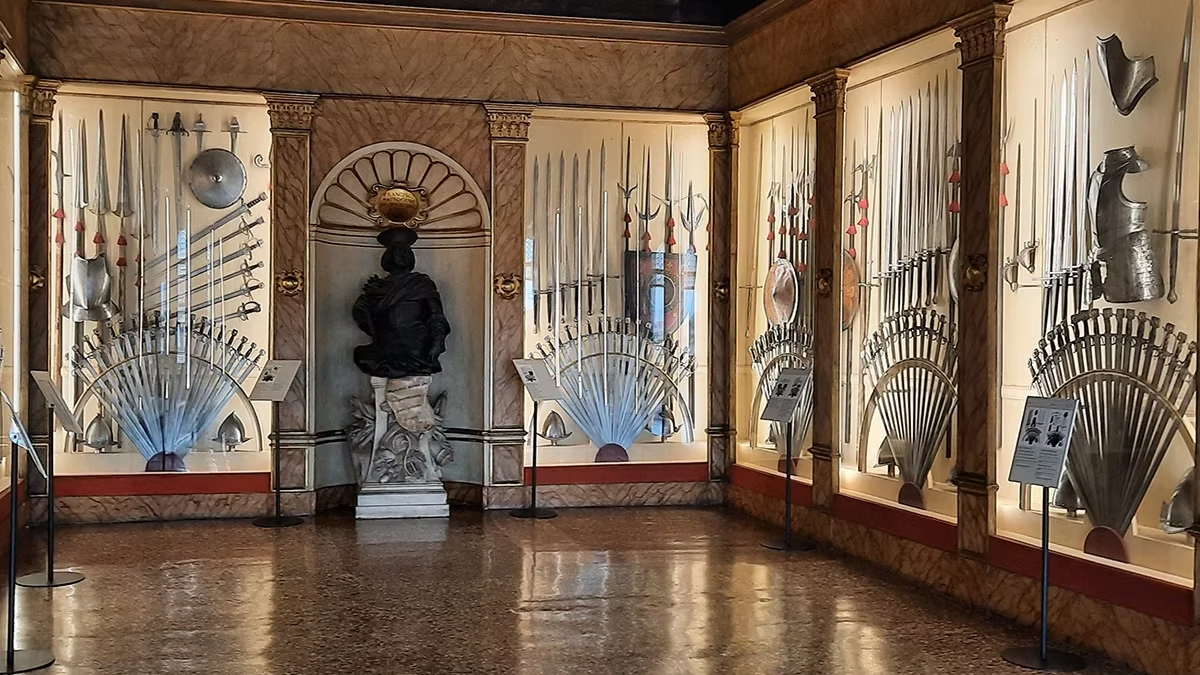
The Armoury (Armeria) is a four-room collection of approximately 2,000 historical weapons and armour spanning the 14th through 17th centuries. Administered during the Republic by the Council of Ten — Venice’s powerful security council — the collection served both practical and ceremonial purposes. Key highlights include the authentic armour of King Henry IV of France (donated to Venice in 1603), Turkish standards and ship lanterns captured at the Battle of Lepanto in 1571, the armour of condottiero Erasmo da Narni (“Gattamelata”), and a comprehensive range of swords, crossbows, halberds, helmets, and firearms. The Armoury is one of the most popular sections with families and children. Plan 15–25 minutes.
The Armoury is often the section of the Doge’s Palace that surprises visitors the most. After 60–75 minutes of ceremonial rooms, gold-leaf decoration, and political allegory, the Armoury presents the Republic’s hard edge — actual weapons used to defend and extend Venetian power for four centuries. This guide covers each of the four rooms, the most important individual pieces, and the history of the collection itself.
The Collection: Origin and Purpose
The Armoury dates from the 14th century and was managed throughout the Republic’s existence by the Council of Ten (the secretive security council). Its monogram “CX” is stamped or painted on many pieces. The collection served dual purposes: practical weapons storage for palace guards and ceremonial forces, and a demonstration arsenal of weapons seized from defeated enemies or gifted by allied powers. After the fall of the Republic to Napoleon in 1797, a significant portion of the collection was dispersed (much ended up in French museums or private hands). What survives is approximately 2,000 pieces spanning the 14th–17th centuries.
Administration
The Council of Ten — Venice’s intelligence and security committee — oversaw the Armoury. The Council’s monogram “CX” (Roman numerals for ten) appears on many weapons as a mark of state ownership. This connection reflects how the Armoury was understood: not merely a museum, but a working arsenal supporting the state’s coercive power.
Public Access During the Republic
The Armoury was closed to the general public during the Republic’s existence. Its contents were considered sensitive — a full inventory of state weapons was intelligence that could aid Venice’s enemies. The collection opened occasionally for high-status visitors: notably when King Henry III of France visited Venice in 1574, triggering one of the only documented public viewings.
Dispersion After 1797
When Napoleon’s forces ended the Venetian Republic in 1797, substantial portions of the Armoury were removed:
- Finest pieces sent to French museums
- Other weapons sold privately
- Some pieces looted or lost entirely
The current collection represents what remained plus some subsequent acquisitions. Approximately 2,000 pieces across four rooms — a fraction of the Republic-era inventory.
The Four Rooms
The Armoury occupies four connected rooms on the second floor of the palace, entered from the Sala della Bussola and exited into the Sala dello Scrutinio. Each room has a distinct focus: Hall I (Gattamelata Hall) displays Renaissance-era armour and mounted combat equipment; Hall II holds the major trophies including Henry IV’s armour and Lepanto captures; Hall III focuses on swords, polearms, and helmets; Hall IV contains firearms, torture instruments, and later-period weapons. You walk through all four rooms in sequence as part of the standard visitor route.
| Hall | Focus | Highlights |
|---|---|---|
| Hall I — “Gattamelata” | Renaissance mounted combat | Gattamelata’s armour, horse armour, early swords |
| Hall II | Trophies & ceremonial | Henry IV’s armour, Lepanto captures, Duodo’s armour |
| Hall III | Edged weapons | Schiavone swords, Landsknecht spadons, Morion helmets |
| Hall IV | Firearms & later period | Muskets, arquebuses, pistols, torture instruments |
Hall I — The Gattamelata Hall
Named for the armour of Erasmo da Narni (1370–1443), called “Gattamelata” (literally “Honey-Cat”), the famous condottiero who served Venice as commander of its mercenary forces. Gattamelata is best known today through Donatello’s bronze equestrian statue of him in Padua — one of the Renaissance’s defining sculptures.
Key contents:
- Gattamelata’s armour: 15th-century plate armour
- Horse armour (barding): 16th-century, used in tournaments and ceremonial combat
- Early swords and daggers: various 14th–15th century
- Painted leather quivers: housing crossbow bolts (ornate decorative work)
- Ship lanterns from captured Turkish galleys: with the characteristic crescent moon symbol
This room sets the tone: Venice’s military power came substantially through hired condottieri (mercenary commanders) rather than a large standing citizen army. Gattamelata was one of the Republic’s most successful military employees.
Hall II — The Trophy Hall
The most artistically important room, containing the Armoury’s most famous individual pieces.
The Henry IV armour:
- Authentic armour of King Henry IV of France (1553–1610)
- Gifted to the Venetian Republic in 1603: (some sources say 1604)
- Bullet marks on the chest plate: from a “proof test” fired after manufacture to verify bullet-resistance
- Weight approximately 23 kg (50 lbs): lighter than visitors typically expect
- One of the finest examples of late-16th-century French royal armour outside France
Henry IV (“Le Bon Roi Henri”) was a strategic ally of Venice against Spanish and Papal power. The armour gift was a diplomatic gesture cementing the France–Venice alliance — and a personally significant one, as this was armour the king had actually worn.
The Lepanto trophies:
The Battle of Lepanto (7 October 1571) was the defining naval victory of 16th-century Venice — a combined Christian fleet led by Don Juan of Austria, with major Venetian participation, defeated the Ottoman Navy off the coast of Greece. The defeat effectively ended Ottoman naval dominance in the Mediterranean.
The Armoury preserves captured Ottoman materials:
- Triangular Turkish standard: with Arabic inscriptions from the Quran and proclamations of Allah and the Prophet Muhammad
- Ottoman ship lanterns: with the crescent moon design
- Various weapons captured from Turkish galleys: curved swords, firearms, armour
These trophies served as tangible proof of Venetian glory — visible symbols of what had been defeated.
The Francesco Duodo armour:
Admiral Francesco Duodo (1518–1592) commanded the Venetian fleet at Lepanto. His preserved armour in the Armoury is a direct personal artifact of that victory.
Hall III — The Edged-Weapons Hall
Focus on swords, polearms, and helmets:
- Schiavone swords: (1480–1490): traditional weapon of the Doge’s personal guard, with distinctive S-curved horizontal crossguards
- Two-handed Landsknecht spadons: (1560–1580): massive ceremonial swords used by German mercenary foot soldiers
- Halberds and polearms: various 15th–17th century
- Morion and Cabasset helmets: (second half of 16th century): mostly from Brescia armouries. The “Morion-Cabasset” (also called Spanish Morion) is the helmet style still worn by the Swiss Guard at the Vatican today
- Tournament armour: ceremonial pieces
The schiavone deserves specific attention: it was the traditional weapon of the Doge’s Guard (the ducal ceremonial force), and examples from the late 15th century show the evolution of Venetian sword design.
Hall IV — The Firearms Hall
Contains the collection’s later-period weapons and miscellaneous items:
- Muskets and arquebuses: 16th–17th century, many made by German gunsmiths or at Brescia: (Venice’s major arms-manufacturing town)
- Pistols: including rare ornate pieces
- Early hand cannons: and small-caliber artillery
- Torture instruments: including thumbscrews, pressing devices, and a chastity belt (the latter more historical curiosity than genuine medieval artifact)
- Miscellaneous weapons: blowpipes, exotic weapons from Venetian Mediterranean contact
The torture instruments are genuinely disturbing to some visitors — less for their quantity than their specificity of purpose. The Republic had a sophisticated judicial apparatus, and some of this room’s contents reflect that.
Why This Section Matters
The Armoury is historically significant because it represents the material power behind Venice’s diplomatic and cultural achievements. The Republic wasn’t just an art-loving merchant city — it was a military state that built the Arsenale (the largest shipyard in pre-industrial Europe), maintained a standing war fleet, and fought major campaigns for centuries. The Armoury makes this concrete. Venice’s cultural production was supported by military power, not separate from it.
The contrast with the rest of the palace is deliberate. The ceremonial rooms display Venice’s self-image as a divinely blessed Republic of virtuous governance. The Armoury shows what that governance was willing and able to defend with force.
The Council of Ten and the Armoury
The Consiglio dei Dieci (Council of Ten) was the Republic’s powerful security and intelligence committee — despite the name, it typically operated with 17 members. Its administration of the Armoury reflects the fusion of internal security and external defense in Venetian governance:
- Weapons for the Doge’s personal guard
- Weapons for ceremonial forces during state occasions
- Emergency stockpile for sudden defensive needs
- Confiscated weapons from prosecuted nobles or foreign enemies
The “CX” monogram on many pieces served as ownership marking, inventory control, and ideological statement — these weapons belonged to the Council of Ten as an institution, not to individual doges or military commanders.
For the room where the Council of Ten met: Doge’s Palace Rooms Guide.
Position in the Visitor Route
The Armoury is visited after the Sala della Bussola and before the Sala dello Scrutinio. Most visitors arrive here approximately 75–90 minutes into a standard self-guided visit, or 50–60 minutes into a guided tour. The four rooms connect in sequence — you walk through Hall I, II, III, IV and exit into the next section of the route. Typical time: 15–25 minutes for most visitors; enthusiasts easily spend 30–45 minutes.
Standard sequence:
- Sala della Bussola (denunciation slot room)
- Armoury Hall I: Gattamelata
- Armoury Hall II: Trophies
- Armoury Hall III: Edged weapons
- Armoury Hall IV: Firearms
- Sala dello Scrutinio (ballot counting)
- Chamber of the Great Council (climactic room)
See Doge’s Palace Map & Floor Plan for the full layout.
The Armoury with Kids
The Armoury is one of the strongest family-engagement sections of the palace. Children aged 6–14 typically find it the most interesting part of the visit. Specific engagement factors:
- Visible, identifiable weapons: swords, crossbows, helmets, pistols: kids recognize these from games, films, history lessons
- Story connections: the Henry IV armour, the Lepanto trophies, Gattamelata’s armour all have narratives attached
- Variety: each hall has a distinct theme, preventing the monotony that kids sometimes feel in purely art-focused rooms
Parents can frame the visit around specific questions: “How heavy is the armour?” (Henry IV’s weighs about 23 kg), “Who won the Battle of Lepanto?” (Venice and allies, 1571), “What’s the crescent moon symbol?” (Ottoman).
See Visiting Doge’s Palace with Kids for family-specific guidance.
How to See the Armoury Properly
Recommended approach for interested visitors:
- Hall I: focus on the Gattamelata armour and horse armour; 3–4 minutes
- Hall II: spend the most time here: (5–8 minutes) on Henry IV’s armour and the Lepanto trophies
- Hall III: the schiavone swords and Landsknecht spadons for variety; 3–5 minutes
- Hall IV: firearms evolution is interesting but skip-able; 2–4 minutes
For casual visitors: walk through all four rooms in 10–15 minutes, pausing only at Hall II’s headline pieces.
Photography Tips
- No flash: (as throughout the palace)
- Many pieces are displayed behind glass: reflections are a challenge; shoot at angles to minimize glare
- Close-ups of individual pieces: work better than wide room shots
- Good lighting: on individual pieces: modern LED display lighting is calibrated for visibility
Historical Context
Medieval Origins
Venice maintained weapons stores from the earliest days of the Republic. The 14th-century Council of Ten took over centralized arsenal management, formalizing the Armoury as a state institution.
Renaissance Peak
The 15th–16th centuries saw the Armoury’s most active period. Venice’s wars against the Ottoman Empire, the Italian states, and various European coalitions kept the Republic’s military establishment well-equipped and well-stocked. Captured trophies and diplomatic gifts (like Henry IV’s armour) accumulated in the collection.
Decline and Dispersion
By the 17th–18th centuries, Venetian military power had declined. The Armoury became more museum than working arsenal. Napoleon’s conquest in 1797 accelerated the dispersion — the finest pieces were removed, and the Republic that had curated the collection ceased to exist.
The Modern Collection
The current ~2,000 pieces represent a surviving fraction of the Republic-era inventory. Restoration and conservation work has preserved the best pieces in displayable condition.
Frequently Asked Questions
What is the Armoury in the Doge’s Palace?
A four-room historical weapons and armour collection containing approximately 2,000 pieces spanning the 14th–17th centuries. Administered during the Republic by the Council of Ten.
What are the most famous items in the Armoury?
King Henry IV of France’s armour (donated 1603), Turkish standards and ship lanterns captured at the Battle of Lepanto (1571), the Gattamelata armour (15th century), and Admiral Francesco Duodo’s armour (commander at Lepanto).
How heavy is Henry IV’s armour?
Approximately 23 kg (50 lbs) — lighter than visitors often assume. Functional Renaissance plate armour was designed for mobility, not just protection.
What’s the “CX” monogram I keep seeing on the weapons?
Roman numerals for “10” — the monogram of the Council of Ten, which administered the Armoury during the Republic. Stamped or painted on many weapons as ownership marking.
Was the Armoury open to the public during the Republic?
No. It was typically closed to ordinary visitors. Known public openings occurred only for high-status visitors — notably King Henry III of France’s 1574 visit.
How long should I spend in the Armoury?
15–25 minutes for a standard visit. Enthusiasts of military history can spend 30–45 minutes. Casual visitors can walk through in 10–15 minutes.
Are there torture instruments in the Armoury?
Yes, in Hall IV. Mostly 16th–17th century judicial torture devices. Some visitors find these disturbing — skippable if you prefer to avoid.
Is the Armoury suitable for children?
Yes, and generally one of the favourite sections for children 6+. The specific content (torture instruments in Hall IV) may be too intense for very young or sensitive children.
Can I photograph the weapons?
Yes, without flash. Most pieces are displayed behind glass, which creates reflection challenges. No tripods or selfie sticks.
What happened to the rest of the original collection?
Napoleon’s 1797 conquest dispersed substantial portions. Finest pieces went to French museums; others were sold or lost. The current ~2,000 pieces represent what survived.
How does this compare to other European armour collections?
The Doge’s Palace Armoury is one of the most historically significant European weapons collections. Larger collections exist (the Tower of London Royal Armouries, the Vienna Hofjagd- und Rüstkammer), but the Venetian collection’s direct connection to an active maritime republic gives it unique character.
Is the Armoury wheelchair accessible?
Yes. All four halls are on the second floor with step-free access once you reach the floor. See Doge’s Palace Accessibility Guide for details.
Can I buy replicas of weapons from the shop?
The palace bookshop occasionally sells books about the Armoury collection. Actual weapon replicas are not typically available.
